Auto Ranging Multimeter Explained: A UK Buyer's Guide
Key Takeaways
- An auto ranging multimeter selects the correct measurement range for you, making testing quicker and reducing user error.
- For UK electricians, maintenance teams and serious DIY users, True RMS accuracy, CAT safety rating and build quality matter more than headline features.
- Auto ranging is especially useful when checking unknown voltages, troubleshooting mixed systems and moving between domestic, commercial and light industrial work.
- Buying from a specialist UK supplier helps with product authenticity, aftersales support and fast dispatch when downtime costs money.
- If you want deeper background reading, see The Ultimate Guide to Multimeter With Auto Ranging in the UK.
Choosing the right meter is not simply a matter of picking the cheapest screen with test leads in the box. In real working conditions across the UK, an electrical fault can sit inside anything from a domestic consumer unit to HVAC controls, plant equipment or low-voltage distribution systems. The wrong meter slows diagnosis; the right one helps you work faster, safer and with more confidence.
That is where the auto ranging multimeter earns its place. For many professionals, it has become the default choice because it removes a layer of manual setup and helps avoid common range-selection mistakes. At DigitalMul, our focus is on trade-grade electrical multimeters trusted by UK electricians, with genuine stock, fast dispatch and the accuracy expected from professional Fluke multimeters and True RMS digital multimeters.
This guide explains what auto ranging means in practical terms, when it matters, what features are worth paying for and how to choose a model that suits your work in Britain.
What is an auto ranging multimeter?
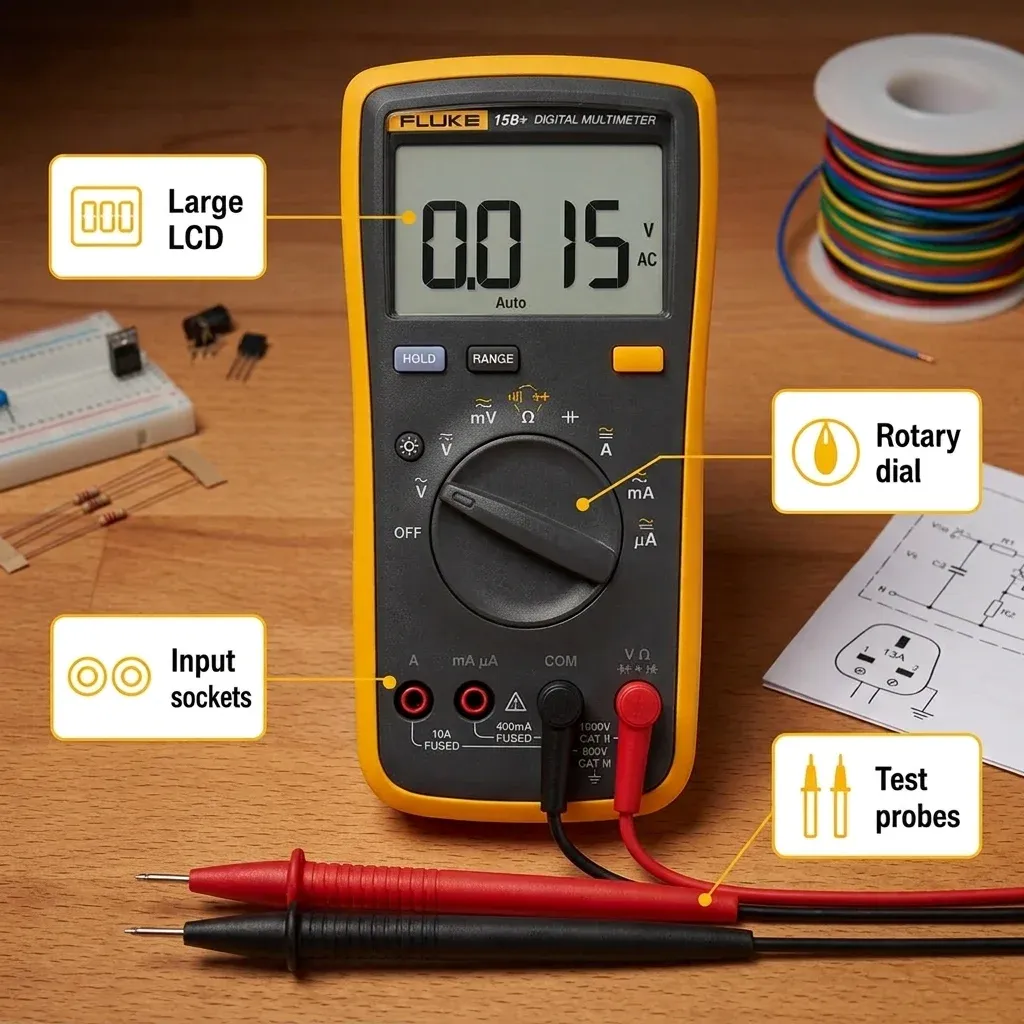
An auto ranging multimeter is a digital meter that automatically selects the most suitable measurement range for the value being tested. Instead of manually choosing whether you are measuring 2V, 20V or 200V, the meter detects the signal and displays it within an appropriate range.
In simple terms, if you are measuring an unknown voltage on a circuit, an auto ranging meter does the range selection for you. That makes it easier to get a stable reading without cycling through multiple settings first.
How it differs from a manual ranging meter
A manual ranging multimeter requires the user to select a measurement band before testing. That approach still has its place and some experienced technicians prefer it in very specific situations. If you want a comparison point, read Non Digital Multimeter Explained: A UK Buyer's Guide.
The main difference is convenience combined with speed. An auto ranging model reduces setup decisions during live fault-finding. On busy jobs where you move repeatedly between continuity, resistance and voltage checks, that efficiency becomes valuable very quickly.
What “auto ranging” does not mean
Auto ranging does not make every meter equally accurate or equally safe. It only refers to how ranges are selected. Build quality, input protection, calibration stability, display clarity and CAT safety rating remain critical factors.
It also does not remove the need for competent use. Safe isolation procedures, correct probe placement and awareness of circuit conditions still apply at all times under normal UK electrical working practices.
Why auto ranging matters for UK buyers
The British market has its own practical demands. Electricians often move between domestic installations at 230V nominal mains supply, commercial distribution boards, controls work and maintenance diagnostics across mixed environments. A meter that can adapt quickly to changing readings saves time without sacrificing reliability.
In healthcare estates such as NHS facilities, schools, local authority buildings and managed commercial properties, maintenance teams may need to troubleshoot efficiently while minimising disruption. Clear readings and fewer setup steps can support faster first-pass diagnosis.
Useful for unknown readings
If you are not certain what value will appear at the test point, auto ranging is especially handy. Rather than stepping cautiously through ranges by hand, you can select the function and let the instrument settle on a sensible scale.
Helpful under pressure
On site, distractions happen. Lighting can be poor. Access can be awkward. Timelines can be tight. An auto ranging multimeter removes one avoidable source of user error when switching tasks rapidly across different circuits.
A better fit for mixed-skill environments
Not every buyer is a senior approved electrician with decades of fault-finding experience. Facilities staff, apprentices under supervision and serious DIY users often find auto ranging models more approachable because they shorten the learning curve while still delivering professional-level measurements when chosen well.
The core functions to expect from an auto ranging multimeter
The feature list varies by model, but most modern trade-grade meters cover standard electrical testing tasks.
- AC/DC voltage measurement
- AC/DC current measurement
- Resistance measurement
- Continuity testing with audible buzzer
- Diode test function
- Capacitance on selected models
- Frequency measurement on selected models
- Temperature input on selected models
- Min/Max recording or hold function
- Backlit display for low-light work
If your work regularly involves non-linear loads such as variable speed drives or electronic power supplies, prioritise a True RMS model rather than relying on average-responding units. That aligns closely with DigitalMul’s emphasis on professional Fluke multimeters and True RMS digital multimeters built for dependable field use.
True RMS vs standard readings: why this matters in Britain
A great many modern installations no longer present perfectly clean sine-wave conditions. LED drivers, inverter systems, motor controls and switched-mode power supplies can distort waveforms. In those cases, a standard average-responding meter may not show an accurate AC reading.
A True RMS meter is designed to measure AC voltage or current more accurately under those real-world conditions. For trade users dealing with modern building services or industrial controls in the UK, this is often far more important than extra secondary features.
A relevant data point
The Health and Safety Executive reported 135 workers killed in work-related accidents in Great Britain in 2022/23 across all industries (HSE fatal injuries statistics). Not all of these incidents were electrical, but the wider lesson is clear: safety-critical tools should never be treated as basic commodities.
A dependable meter with proper category rating and robust input protection is part of sensible risk control. That is one reason many professionals prefer established brands with proven field performance rather than anonymous imports of uncertain origin.
When True RMS should be non-negotiable
- You test panels containing drives or inverters.
- You work on commercial lighting circuits using electronic drivers.
- You diagnose HVAC equipment with control electronics.
- You measure generator or UPS outputs.
- You want readings you can trust across mixed waveform conditions.
If you want broader context around these buying criteria, our pillar guide covers them in more detail: The Ultimate Guide to Multimeter With Auto Ranging in the UK.
The most important buying criteria for an auto ranging multimeter
If you are comparing models online across price points that look similar at first glance,. these are al check things will have far more impact than marketing claims:Säfety category rating (CAT)
The CAT rating tellstells tou how suitable/ protectedmeter protected meters are against transients in specific electrical environments.. For examplepp, CAT III`an CAT IV ratingsare typical considerationsetionsons for professionals working ony distribution circuits,c consumer unitssoardsr or service entrances-like environments. `You should match thend retingng tothe environmentent,m not just pickpickb based<>based on lowest price`.
If’s p;you`re working within domestic / light commercial installationenvironments in thee UK,, category safety should be near then top opf your checklist., especially ifing if use could extend beyone bench electronics use.. IET Wiring Regulations shape safe practice expectations across British electrical work,, even though product selection still needs task-specific judgement. See our wider overview here: The Ultimate Guide to Multimeter With Auto Ranging in the UK.
`Accuracy`, resolution`.and counts` ` ` ` ` ` ` ` ` ` ` `
A meter may be autoeurosp;auto-ranging yet still feel disappointing if its resolution is poor poor or its stated accuracy figures don’t suit fine diagnostic work. Look at:
- % accuracy specification for voltage / resistance / current ranges;
- `display counts` (for example ,6000-count vs lower-count displays);`
- whether low-value changes show clearly enough during troubleshooting ;`
- `response speed` when readings fluctuate.`
< /ul>
If uou routinely compare supply levels,, trace intermittent faults orn subtle dropsrops,, ah clearer higher-count display can make your job easier.
PBuild qualityqand lead quality< / h3> The best metre is one y0u trust after months inn van storage , ladder workk aand damp winter call-outs. Check:
- `case durability`and overmoulded protection;
- `screen readability`in poor light;
- `button / rotary switch feel`;
- `quality off included test leads``and probe shrouding;
- `battery compartment design`and fuse access.`
< / ul>
Poor leads can undermine even even an okay okay meter . Professional users generally prefer proven accessories accessories because cheap probes wear quickly , produce inconsistent contact or inspire little confidence around live testing .
`True RMS capability`< / h3>
This deserves repeating because buyers often underrate it. If your environment includes modern loads,theer’s no point saving marginal money onlyto accept questionable AC accuracy. A genuine trade-grade True RMS auto-rangeingrnging meter is usually better value over time than replacing aa budget instrument that cannot keep up with real site conditions condition.
`Speed of autoranging`< / h3>
Nott all auto-range implementations feel equally smooth.sm0oth Some meters take too long to settlele,, especially when changing functions ors moving between low/high valuesues. For regular fault-findinginding,, that lagg becomes annoying. Good instruments give fast stable readings without hunting excessively between scales.
`Brand trust``and authenticity`< / h33> This matters more than many online listings suggest. Counterfeit or grey-market electrical tools do appear in circulationculation,and they create obvious concerns around safety,specification complianceand warranty support. Buyingfrom apro specialist UK supplier offering genuine stock gives stronger assurance over what actually arrives.
This iss one reason professionals gravitate towards recognised names such as Fluke when reliability,repeatabilityand support matter.matter For readers considering one specific model familyamily,, our article Tis 258 Digital Multimeter Explained: A UK Buyer's Guide offers useful extra context.`
Anyonecan use one,but certain buyer groups tend togett he greatest practical benefit benefit from automatic range selection .
You canalso startwith our cornerstone buying resource:
The Ultimate Guide to Multimeter With Auto Ranging in the UK.
A cheap meter may prove false economy if readings drift ,build quality disappointsor safety credentialsare weak.
Thisisa major error ifthe instrument will be used beyond low-energy electronics.
//
Match category rating toelectrical environmentenvironment.
They are notnot .,and inaccurate AC measurements on distorted waveforms can mislead troubleshooting decisions decisions.
A clear display,reliable continuity buzzer,durable leads,and stable accuracy often mattermore than rarely used extrasextras.
Genuine stock from aa specialist retailer reduces riskrisk around counterfeits,warranty confusionor non-compliant accessoriesaccessories.
< /ol>
Ready to upgrade your diagnostics with {brand_name}?
View the Range — £209.30